
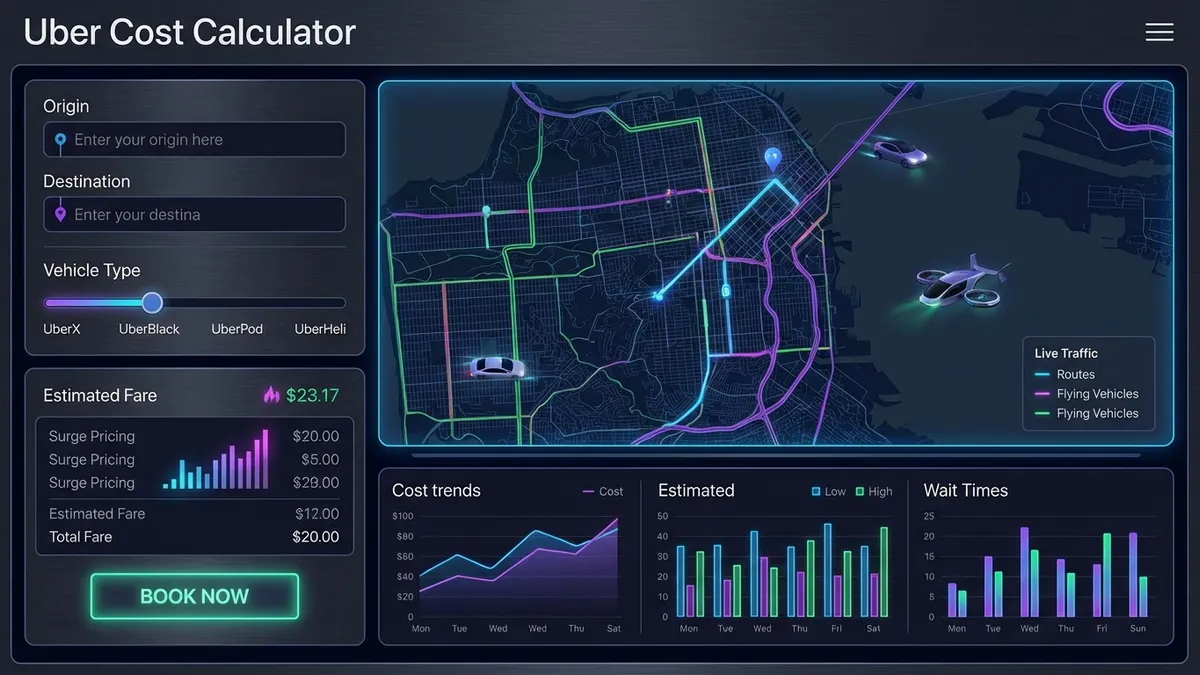
How to Estimate Your Uber Fare Without Logging In
Planning a trip and need a quick Uber estimate? You don't need to open the Uber app or create an account. Our Uber Cost Calculator gives you an instant fare estimate for any trip based on distance, time, and current demand — completely free and without a login. This is especially useful when you're budgeting a vacation, comparing transportation options, or simply curious about how much an Uber ride might cost before you commit.
The tool covers all five major Uber ride types: UberX Share, UberX, Uber Comfort, UberXL, and Uber Black. Enter your estimated distance in miles or kilometers, set the expected travel time, and adjust the surge multiplier if you're riding during peak hours. You'll see a side-by-side fare comparison that helps you pick the best option for your budget.
How Uber Calculates Your Ride Cost
Understanding the formula behind Uber's pricing helps you predict when rides will be cheaper and avoid overpaying. Unlike a traditional taxi meter that ticks up visibly, Uber's pricing algorithm works behind the scenes using four main components. Knowing these factors puts you in control of your ride budget. If you want to see those components itemized for a single ride, our Uber fare calculator breaks the price down line by line, from base fare to tip. To compare the price across UberX, Comfort, XL, and Black before you book, run your route through our Uber ride estimate. For the full arithmetic behind every tier — including the 13 mph point where the per-minute charge starts costing more than the per-mile charge — read our guide to how to calculate Uber and Lyft costs.
Base Fare
A flat fee charged for starting the ride, similar to a taxi's "flag drop." It varies by city and service level — UberX starts around $1.00, while Uber Black starts around $7.00.
Time & Distance Rates
You're charged per minute and per mile. Stuck in traffic? The time component increases. Longer route? The distance component increases. For UberX, expect about $0.20/min and $0.90/mile on average.
Booking & Service Fees
A flat "Booking Fee" (typically $2.00–$4.00) covers Uber's safety, regulatory, and operational costs. This goes directly to Uber, not the driver, and is separate from the base fare.
Surge Pricing Multiplier
When demand exceeds driver supply, a multiplier is applied to the entire fare. A 2.0x surge means your ride costs double the normal rate. Use our surge slider to see the impact on your estimate.
Uber Ride Estimate: Service Levels Compared
Uber offers five main ride types, each designed for different needs and budgets. Choosing the right service can save you 30–50% on the same trip. Here's what you need to know about each option so you can make an informed decision when comparing fare estimates.
UberX Share (Most Affordable)
UberX Share (formerly Uber Pool) lets you share your ride with other passengers heading in a similar direction. It's the cheapest option available, often 25–40% less than a standard UberX. The tradeoff is a slightly longer trip time since the driver may pick up or drop off other riders along the way. It's ideal for solo riders who aren't in a rush.
UberX (The Standard)
UberX is the most popular and affordable private ride option for everyday trips. It provides a ride in a standard sedan (like a Toyota Camry or Honda Civic) for up to 4 passengers. It's perfect for commuting to work, running errands, or heading to dinner. This is the service level most people mean when they say "taking an Uber."
Uber Comfort (Extra Legroom)
Uber Comfort is a step up from UberX, offering newer cars (under 5 years old), extra legroom, and top-rated drivers. You also get to set temperature and conversation preferences before the ride. It typically costs about 20–40% more than UberX. If you're tall, have luggage, or just want a nicer experience, Comfort is a solid middle-ground option.
UberXL (For Groups)
Need more space? UberXL sends a minivan or SUV (like a Toyota Sienna or Ford Explorer) that seats up to 6 passengers. It's also great if you have lots of luggage, even traveling solo. Expect to pay about 1.5x to 2x the price of UberX. When splitting the cost among 5–6 people, UberXL often works out cheaper per person than individual UberX rides.
Uber Black & Black SUV (Premium)
Uber Black is the premium tier with professionally licensed drivers in luxury vehicles with black exteriors and leather interiors. Prices are typically 3–4x higher than UberX, but you get a first-class experience. Uber Black SUV accommodates up to 6 passengers in a luxury SUV. Both are popular for business travel, airport transfers, and special occasions.
Uber Fare Estimate: What Does a Typical Ride Cost?
We've put together a reference table showing estimated fares across common trip types so you can quickly gauge what your ride might cost. These estimates are based on U.S. national average rates at normal demand (no surge). Your actual fare may be higher or lower depending on your city, traffic conditions, and time of day.
| Trip Type | Distance | Time | Est. UberX | Est. UberXL |
|---|---|---|---|---|
| Short City Hop | 2 mi | 10 min | $7 – $10 | $12 – $16 |
| Cross-Town Ride | 8 mi | 20 min | $14 – $19 | $23 – $30 |
| Airport Run | 15 mi | 30 min | $23 – $30 | $38 – $49 |
| Suburban Commute | 25 mi | 40 min | $34 – $44 | $57 – $72 |
| Long Distance | 50 mi | 60 min | $62 – $78 | $105 – $130 |
Uber Price Estimator: 7 Ways to Save Money
Rideshare costs can add up fast, especially if you ride multiple times a week. Here are seven proven strategies we recommend to keep more money in your pocket while still getting where you need to go safely and on time.
- Wait Out the Surge: Surge pricing is dynamic and can change every few minutes. If you see a high multiplier (2.0x or more), wait 5–10 minutes before requesting. More drivers usually come online, and the price often drops back to normal rates. Wait before you book, though — cancelling a ride you already requested to chase a lower price costs $5 on UberX once the two-minute window closes, which our rideshare cancellation fee calculator prices out in full.
- Walk a Few Blocks: Being in a high-demand zone (right outside a concert venue or sports stadium) triggers surge pricing. Walking a few blocks to a quieter street can significantly lower your fare without much effort.
- Compare UberX Share vs. UberX: If you're riding solo and have a few extra minutes, UberX Share can save you 25–40% compared to a standard UberX ride. Use our calculator to see the price difference for your trip.
- Schedule Your Ride: Uber lets you schedule rides up to 30 days in advance through its "Reserve" feature. While the price is often slightly higher than on-demand, it protects you from extreme surge during events or rush hours.
- Check Lyft and Local Taxis: Always compare prices across apps. Uber may be surging while Lyft isn't, or vice versa. Read more about the key differences between Uber and Lyft pricing on Investopedia.
- Uber One Membership: If you ride frequently, the Uber One subscription ($9.99/month) offers 5% off eligible rides and $0 delivery fees on Uber Eats. Do the math — if you spend more than $200/month on rides, it pays for itself. Most members actually clear the fee on the food side first: our Uber Eats fee calculator puts that break-even at roughly three delivery orders a month.
- Ride During Off-Peak Hours: Early mornings (before 7am), mid-afternoon (1pm–4pm), and late evenings (after 9pm on weekdays) typically have the lowest demand and fares. Plan your schedule around these windows when possible.
There's an eighth strategy that only applies on trips: at some point, riding stops being the cheap option. Four or five Uber trips a day for a week will clear what a rental car costs — but only if you compare against the rental's real total, not its advertised daily rate. A $52/day booking lands closer to $117/day after airport concession fees, facility charges, the damage waiver and tax. Our car rental cost calculator builds that number line by line so the comparison is honest in both directions.
How Our Uber Cost Estimator Works
Our calculator uses the same pricing formula that Uber applies internally: (Base Fare + Per-Minute Rate × Time + Per-Mile Rate × Distance + Booking Fee) × Surge Multiplier. We use U.S. national average rates for each service tier, sourced from publicly available Uber rate card data. The tool then adds a ±10% range to account for real-world variables like traffic routing and local rate differences.
You can toggle between miles and kilometers for international trips, enable round trip to double the estimate, and slide the surge multiplier from 1.0x (normal) to 4.0x (extreme demand). For the most accurate result, use Google Maps to get your exact trip distance and estimated drive time before entering them into our calculator.
Uber Taxi Fare Calculator: Uber vs. Traditional Taxis
A common question we hear is whether Uber is cheaper than a regular taxi. The answer depends on distance, city, and current demand. For short trips (under 5 miles) during normal demand, UberX is typically 15–30% cheaper than a metered taxi. For longer trips (15+ miles), the savings can be even greater because Uber's per-mile rate is usually lower than a taxi's meter rate.
However, during surge pricing (2.0x or higher), a taxi with a regulated meter rate is often the better deal. That's why we recommend always checking both options before committing. Price the cab side with our taxi fare calculator, or run both at once through the taxi vs Uber calculator, which solves for the exact break-even surge multiplier — around 2.01x at national-average rates, but as low as 1.41x in Boston.
According to the U.S. Bureau of Labor Statistics Consumer Price Index, ride-hailing services have seen fare increases of approximately 15% since 2020, largely driven by higher fuel costs and driver incentives. Understanding these trends helps you budget for transportation more accurately. Curious what those higher fares mean for the people behind the wheel? Our DoorDash pay calculator shows how much a gig driver actually keeps after gas and mileage.
Uber Ride Cost by City: How Prices Vary
Uber rates differ significantly from city to city due to local regulations, taxes, minimum wage laws, and driver supply. For instance, a 10-mile, 20-minute UberX ride costs approximately $18–$22 in New York City, $15–$19 in Chicago, $13–$17 in Dallas, and $12–$15 in Phoenix. These variations make it important to use a fare estimator before every trip, especially if you're traveling to a new city. Our calculator provides national average estimates as a baseline, but we always recommend checking the Uber app for your specific city's rates. For more information on how Uber's pricing model adapts to different markets, see the official Uber pricing guide.