How to Estimate Gas Cost for a Trip
Whether you are planning a cross-country road trip, budgeting for your daily commute, or simply wondering how much gas will cost for your trip, our gas cost calculator gives you an accurate answer in seconds. Fuel is one of the biggest variable expenses for any driver, and knowing the exact cost before you leave helps you budget smarter and avoid surprises at the pump.
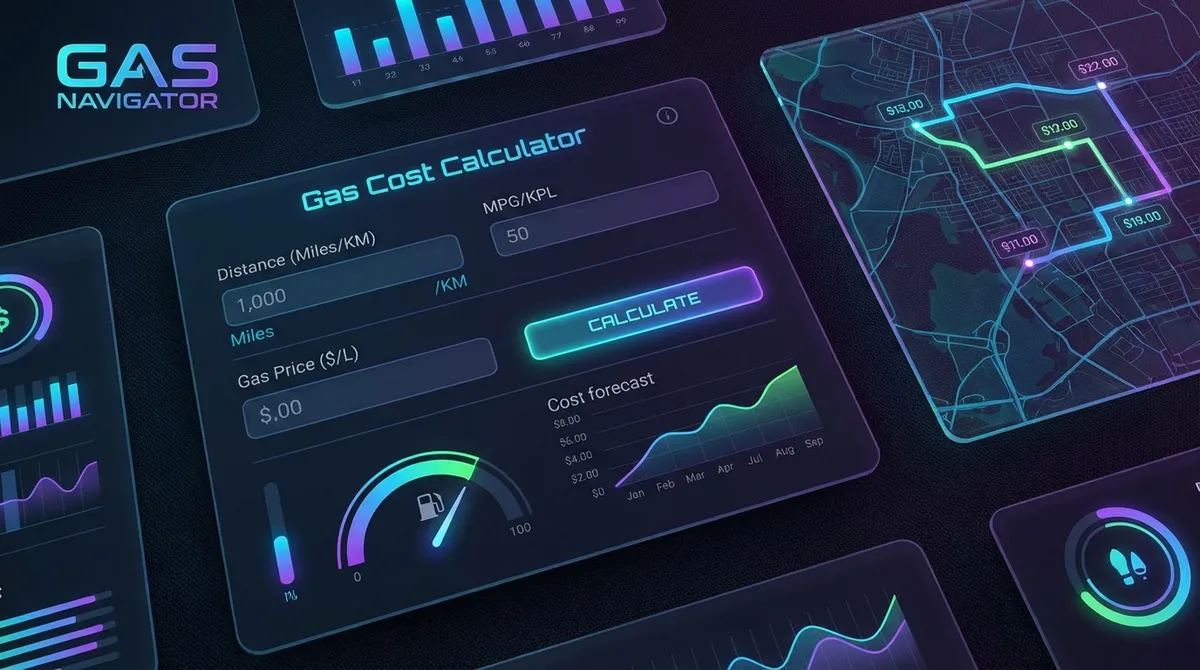
Our gas cost estimator works for any distance — short commutes, weekend getaways, or multi-state drives. Enter your trip distance, your vehicle's MPG, and the current gas price, and the calculator instantly shows the estimated fuel cost, gallons needed, and cost per mile. You can also toggle round-trip mode and add trips per week to see weekly, monthly, and annual fuel cost projections. If you need a more detailed route plan, try our Trip Calculator or Commute Cost Calculator for daily driving estimates.
How the Gas Cost Calculator Works
We built this gas price calculator to be as intuitive as possible. Here is how to get the most accurate estimate for your journey:
- Enter Trip Distance: Input the total distance of your trip in miles or kilometers. You can find this using Google Maps, Apple Maps, or your vehicle's odometer. Toggle between miles and km using the unit switch at the top of the calculator.
- Input Fuel Efficiency (MPG): Enter your vehicle's average miles per gallon. If you don't know your exact MPG, check your car's dashboard display, the window sticker from purchase, or look it up on FuelEconomy.gov. For the most accurate results, use your real-world average rather than the EPA estimate, since highway vs. city driving can shift your actual MPG by 20% or more.
- Set Gas Price: Enter the current price of gas per gallon in your area. Prices vary by station, city, and state, so checking a local price source gives you the most precise figure.
- Toggle Round Trip: If you plan to return to your starting point, flip the round-trip switch. The calculator automatically doubles the distance and updates the cost.
- Add Trips Per Week (Optional): If this is a recurring trip — like a daily commute — enter how many times per week you make it. The calculator will project your weekly, monthly, and annual fuel cost so you can see the true long-term expense.
Results appear after you click Calculate Gas Cost, showing the total estimated cost, fuel needed in gallons and liters, cost per mile, cost per kilometer, and — if you entered trips per week — your projected spending over time.
The Gas Cost Formula Explained
Understanding the math behind the calculator helps you make quick mental estimates when you are on the go. The core formula for calculating gas cost is straightforward:
Total Gas Cost = (Distance ÷ MPG) × Gas Price Per Gallon
Let's break it down with an example. Suppose you are driving 300 miles, your car gets 25 MPG, and gas costs $3.80 per gallon:
- Step 1 — Calculate gallons needed: 300 miles ÷ 25 MPG = 12 gallons.
- Step 2 — Calculate total cost: 12 gallons × $3.80 = $45.60.
- Step 3 — Cost per mile: $45.60 ÷ 300 miles = $0.152 per mile.
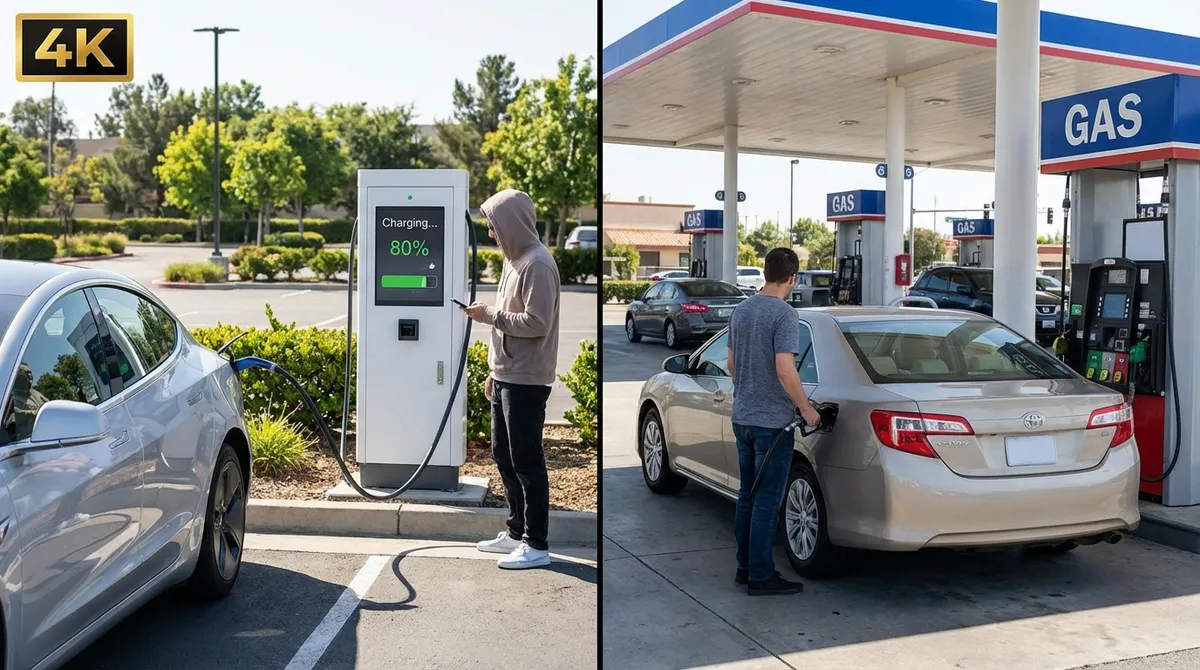
For a round trip, double the distance (or the final cost). In this case, a round trip would cost $91.20 and require 24 gallons. Seeing these numbers in black and white often reveals that "quick trips" are more expensive than we assume. If you want to compare fuel costs between a gas car and an electric vehicle, our EV vs Gas Cost Calculator makes that easy. Shopping for a more efficient car? Our fuel savings calculator shows you the exact dollar difference between two MPG ratings over 1-10 years.
How Much Does Gas Cost Per Mile?
One of the most common questions drivers ask is how much does 1 mile of gas cost. The answer depends entirely on your vehicle's MPG and the current gas price. Here is a quick reference table based on a gas price of $3.50 per gallon:
| Vehicle MPG | Cost Per Mile | Cost for 100 Miles | Cost for 500 Miles |
|---|---|---|---|
| 15 MPG (truck/SUV) | $0.233 | $23.33 | $116.67 |
| 20 MPG (midsize) | $0.175 | $17.50 | $87.50 |
| 25 MPG (sedan) | $0.140 | $14.00 | $70.00 |
| 30 MPG (efficient) | $0.117 | $11.67 | $58.33 |
| 40 MPG (hybrid) | $0.088 | $8.75 | $43.75 |
As you can see, the difference between 15 MPG and 40 MPG is massive over long distances. A 500-mile trip in a truck costs nearly three times more than the same distance in a hybrid. That is exactly why knowing your cost per mile matters — it turns abstract fill-ups into concrete dollar amounts, and our fill-up cost calculator does the same for a single stop at the pump. Planning a longer drive? Our road trip gas cost guide covers the speed penalty, the roof-box tax, and why the cheap-gas detour usually loses money. Considering switching to electric? Check our Gas vs Electric Cars: True Cost Comparison guide.
5 Proven Ways to Lower Your Gas Costs
Now that you know how much you are spending, here are actionable strategies to reduce your fuel bill. These tips apply whether you are commuting five days a week or planning a long road trip.
1. Maintain Proper Tire Pressure
Under-inflated tires increase rolling resistance, forcing your engine to work harder and burn more fuel. According to the U.S. Department of Energy, you can improve your gas mileage by up to 3% simply by keeping your tires inflated to the recommended PSI. Check your owner's manual or the sticker inside the driver's door for the correct pressure — and check it monthly, since tires lose about 1 PSI per month naturally.
2. Drive Smoothly — No Aggressive Acceleration
Aggressive driving — speeding, rapid acceleration, and hard braking — can lower your gas mileage by 15–30% at highway speeds and 10–40% in stop-and-go traffic. Smooth, gradual inputs save gas and reduce wear on your brakes and transmission. A good rule of thumb: pretend there is an egg under your gas pedal that you do not want to break.
3. Remove Excess Weight and Roof Racks
Extra weight forces your engine to work harder. Even 100 extra pounds in your trunk reduces MPG by about 1%. Roof racks and cargo boxes are even worse — they create aerodynamic drag that can cut fuel economy by 10–25% at highway speeds. If your roof rack is not in use, remove it. You will save on every single trip.
4. Avoid Excessive Idling
Idling gets zero miles per gallon. The average car burns roughly a quarter to a half gallon of fuel per hour while idling. If you will be stopped for more than 60 seconds and it is safe to do so, turn off your engine. Modern fuel-injected engines restart efficiently without wasting fuel. For longer commutes, use our Gas Cost Calculator for Trips to find the most fuel-efficient route.
5. Combine Errands and Plan Your Trips
Several short trips from a cold engine can use twice as much fuel as one longer, combined trip covering the same total distance. Your engine operates most efficiently when warmed up, so batching errands into a single outing is one of the easiest ways to cut your weekly gas spending. Use our Trip Cost Calculator to plan efficient multi-stop routes.
Common Myths About Saving Gas
There is a lot of misinformation about fuel economy floating around. Here are three common myths we hear regularly — and the facts that debunk them.
- Myth: Premium gas gives better mileage.
Fact: Unless your vehicle's manufacturer specifically requires premium fuel (typically high-performance or turbocharged engines), using it won't improve your MPG or performance. You are just paying more for no benefit. Check your owner's manual — if it says "recommended" rather than "required," regular unleaded is fine. - Myth: Manual transmissions always get better mileage.
Fact: This was true decades ago, but modern automatic transmissions and CVTs (Continuously Variable Transmissions) are so advanced that they often match or outperform manuals in fuel efficiency. Many new automatics have 8, 9, or even 10 gears specifically tuned for optimal fuel economy. - Myth: You need to warm up your car for several minutes.
Fact: Modern fuel-injected engines need only about 30 seconds to warm up, even in cold weather. The best way to warm your engine and transmission is to drive gently for the first few minutes. Idling just wastes gas and produces unnecessary emissions. Use our MPG Calculator to track whether your warm-up habits affect your real-world fuel economy.
Frequently Asked Questions
Start Saving on Fuel Today
Knowing your exact gas cost is the first step toward smarter travel budgeting. Use our gas cost calculator above to estimate the fuel expense for any trip — whether it is a 10-mile errand or a 1,000-mile road trip. Planning a longer drive with hotel stays and meals? Our road trip cost calculator breaks down gas, lodging, food, and tolls into one total budget. Pair it with the fuel-saving tips in this guide, and you will keep more money in your wallet every time you drive. For a complete picture of your vehicle expenses, explore our full suite of fuel and MPG calculators.