
Calculate Your Car Payment With Interest Rate, Taxes & Down Payment
Buying a car is one of the most significant financial decisions most people make. Whether you are eyeing a brand-new SUV, a reliable used sedan, or a sporty coupe, understanding your monthly financial commitment is crucial before you sign any paperwork. Our car payment calculator with interest gives you a clear, accurate picture of what your monthly payments will look like so you can budget with confidence and negotiate from a position of strength.
By entering key details — vehicle price, your down payment, trade-in value, interest rate (APR), loan term, and local sales tax — you can instantly calculate your car payment and see the full cost breakdown. We show you the estimated monthly payment, total interest paid over the life of the loan, total out-the-door cost including taxes, a visual chart of loan principal and interest, with financed sales tax included in principal, and a year-by-year amortization summary so you can see exactly how your balance decreases over time. This comprehensive view empowers you to compare deals, negotiate better terms, and choose a loan that fits your financial goals.
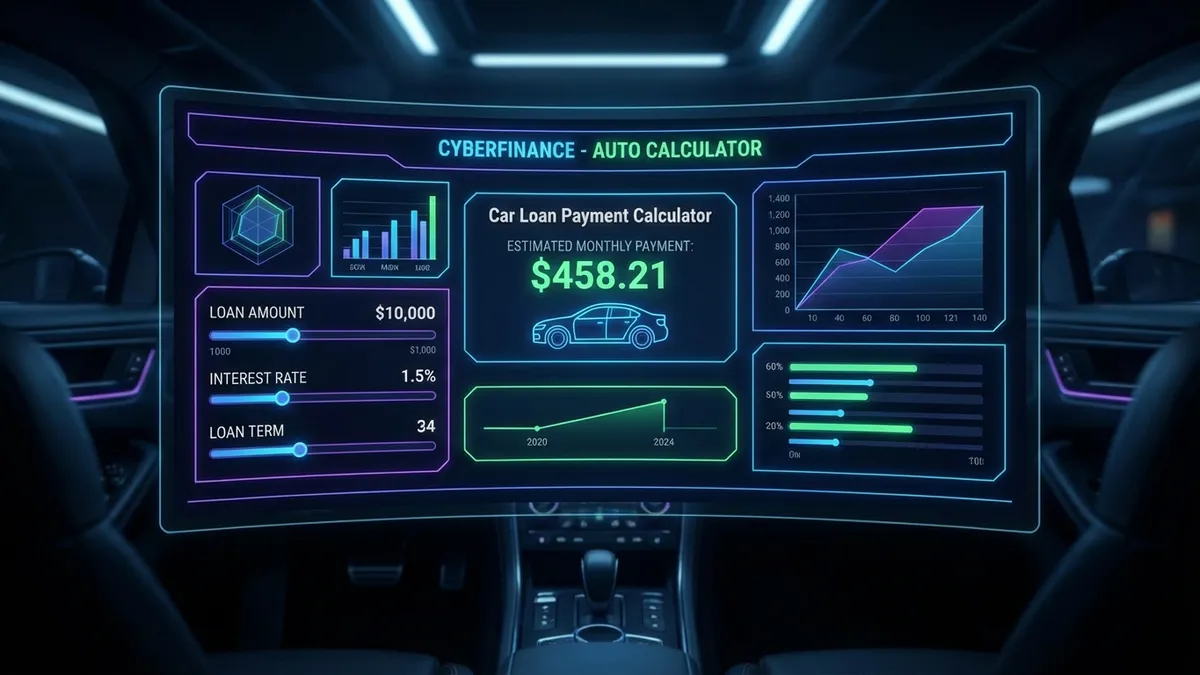
How to Use This Car Loan Payment Calculator
Using this calculator to calculate your monthly car payment is straightforward. Here is a step-by-step guide to getting the most accurate results:
- Vehicle Price: Enter the total purchase price of the car. This is the sticker price or the negotiated price before any taxes or fees. If you are buying used, enter the agreed-upon price.
- Down Payment: Input the amount of cash you plan to pay upfront. A larger down payment reduces the loan amount and, consequently, your monthly payment and total interest paid.
- Trade-in Value: If you are trading in an old vehicle, enter its estimated value here. This amount is deducted from the vehicle price, lowering the amount you need to finance. In many states, trade-ins also reduce the amount subject to sales tax.
- Interest Rate (APR): Enter the annual percentage rate for your loan. Your rate depends on your credit score, the lender, loan term, and whether the car is new or used. Check with your bank or credit union for pre-approval rates.
- Loan Term: Select the duration of the loan in months using the quick-select buttons (24, 36, 48, 60, 72, or 84 months) or type a custom term. Shorter terms mean higher monthly payments but less total interest.
- Sales Tax Rate: Enter your local sales tax rate. This is crucial for an accurate “out-the-door” price estimation. Rates vary by state and sometimes by county or city.
Once you have entered these figures, click “Calculate Payment” to see your results. Adjust any field and recalculate to see how different scenarios — like putting more money down or securing a lower interest rate — affect your bottom line.
Understanding the Components of Your Car Payment
Your monthly car payment is not just a random number. It is composed of three main parts: principal, interest, and taxes or fees. The payment breakdown chart in our calculator visualizes exactly how your money is divided.
- Principal: This is the money that goes directly toward paying off the loan balance. In the early months of a loan, a smaller portion of your payment goes to principal. As you progress through the loan term, more of each payment goes toward principal — a pattern clearly visible in the yearly amortization table.
- Interest: This is the cost of borrowing money, calculated based on your remaining loan balance and your APR. Higher interest rates mean more of your payment goes to the lender rather than paying off the car. Even a 1% difference in rate can mean hundreds or thousands of dollars over the life of the loan.
- Taxes and Fees: While often paid upfront, some buyers choose to roll sales tax and dealership fees into the loan. If you do this, you are paying interest on the taxes as well, which increases the total cost of the car.
For a deeper dive into how interest accumulates month by month, check out our Car Loan Interest Calculator, which focuses specifically on the interest portion of your payments.
How to Calculate Car Payment With Interest Rate Manually
For those who want to understand the math, car loan payments are calculated using the standard amortization formula. This is the same formula that banks, dealerships, and our car loan payment calculator use:
M = P × [ r(1 + r)n ] / [ (1 + r)n – 1 ]
Where:
- M = Total monthly payment
- P = Principal loan amount (vehicle price + tax − down payment − trade-in)
- r = Monthly interest rate (annual percentage rate divided by 100 and then by 12)
- n = Number of months in the loan term
For example, if you borrow $30,000 at a 6% annual interest rate for 60 months: the monthly rate r = 0.06 / 12 = 0.005. Plugging into the formula gives a monthly payment of about $579.98. Over 60 months you would pay roughly $4,799 in total interest on top of the $30,000 principal. Rather than doing this math by hand, our calculator handles it instantly and also factors in your down payment, trade-in, and sales tax.
With the illustrative defaults of a $35,000 vehicle, $5,000 down, no trade-in, 7% sales tax, and a 5.5% annual interest rate for 60 months, tax is $2,450 and the loan amount is $32,450. The estimated payment is $619.83 and total interest is $4,739.96. The chart totals $37,189.96 in loan payments; the $5,000 down payment brings total vehicle cost to $42,189.96, before fees. Tax is already in the loan principal.
This tool assumes fixed monthly payments and excludes loan fees and existing debt on a trade-in. Use the contract interest rate for the payment calculation: the CFPB explains that APR can also include fees. Actual billing dates and lender rounding can change the final payment.
Strategies to Lower Your Monthly Car Payment
If the estimated monthly payment is higher than your budget allows, there are several practical strategies you can use to bring that number down to a more manageable level.
1. Increase Your Down Payment
The most effective way to lower your monthly payment is to borrow less. Every extra dollar you put down reduces both the principal and the interest you will pay. We recommend aiming for at least 20% down to avoid being “upside down” on your loan, meaning you owe more than the car is worth.
2. Improve Your Credit Score
Your credit score is the single biggest factor in determining your interest rate. A higher score qualifies you for lower rates, which directly reduces your monthly payment. Before shopping, check your credit report for errors and pay down existing debt to improve your score. Even moving from “good” to “excellent” credit can save you thousands over the loan.
3. Choose a Shorter Loan Term
While a longer term (72 or 84 months) lowers your monthly payment, it significantly increases the total interest you pay. A shorter term increases the monthly payment but saves you money overall. Use our Auto Loan Calculator to compare how different term lengths affect total cost.
4. Refinance Later
If you are stuck with a high rate now, you can refinance later when your credit improves or market rates drop. See our Auto Refinance Calculator to estimate potential savings from refinancing your current auto loan.
5. Shop Multiple Lenders
Do not accept the first rate you are offered. Get quotes from your bank, credit unions, and online lenders in addition to dealership financing. Multiple loan inquiries within a 14-day window count as a single hard pull on your credit, so there is no downside to comparing offers.
Car Payment Calculator With Interest: How Interest Rates Affect Your Loan
The interest rate you secure has a massive impact on the total cost of your vehicle. To illustrate, here is how different rates affect a $30,000 car loan over 60 months:
- 3% APR: Monthly payment of $539 — total interest paid is $2,349
- 5% APR: Monthly payment of $566 — total interest paid is $3,968
- 7% APR: Monthly payment of $594 — total interest paid is $5,640
- 10% APR: Monthly payment of $637 — total interest paid is $8,248
The difference between 3% and 10% APR is nearly $6,000 in interest alone. That is why shopping for the best rate is one of the most valuable things you can do before buying a car. As of 2025, average new car loan rates range from about 5% for excellent credit (750+) to over 13% for subprime borrowers (below 600). Used car rates are typically 1-2% higher than new car rates.
Additional Resources
For more information on auto financing, consumer rights, and getting the best deal on your car loan, we recommend these authoritative resources:
- Consumer Financial Protection Bureau (CFPB) — Auto Loans: A government resource with guides and tools for navigating auto loans, including how to compare offers.
- Federal Trade Commission (FTC) — Financing or Leasing a Car: Essential advice on your rights and options when financing a vehicle.
- Investopedia — Auto Loans Guide: In-depth articles on how car loans work, current rates, and tips for getting approved.